Dr Tommaso Zerbi
Publications
My key publications include:
“The Middle Ages on the Move: Architecture, Religion, and the Politics of Temporality in Colonia Libya”
Studi e Ricerche di Storia dell’Architettura 19, no. 1 (2026): 114–131
By tracing the anatopic and anachronic displacement of the Middle Ages onto the material and ontological fabrication of colonial Africa, this article probes the mobilisation of the past in imperial and religious politics. Foregrounding temporality and secular–ecclesiastical relations over individual agency and coloniser–colonised dichotomies, it focuses on Libya as a critical arena of expansion and tension between Italy and the Catholic Church. Ecclesiastical architecture, particularly the Cathedral of Tripoli (1928), charts the passage from the distance separating the “two Romes” to their apparent convergence with the advent of Fascism and ultimately the subsumption of religion within the regime. Reconstructing the rise—and crisis—of a striking displacement of the medieval into modes of coloniality, the article problematises future- and antiquity-oriented characterisations of Italian imperialism. The past—above all Francis of Assisi—functioned as a medium of negotiation in attempts to reconcile religion with empire and nationhood, underpinning the circulation of architectural forms and, through mythopoeic narratives of maritime exchange, spatial compression. Temporal mobility sustained the regime’s Mediterranean vision and generated a trans-Mediterranean condition, which recoded the sea from barrier to conduit—symbolically drawing Africa closer to Europe and bringing Italy closer to the Church.

“Rex Utriusque Siciliae: Neo-Medievalism and Revolution”
Architectural History (Cambridge University Press) 68 (2025): 57–90
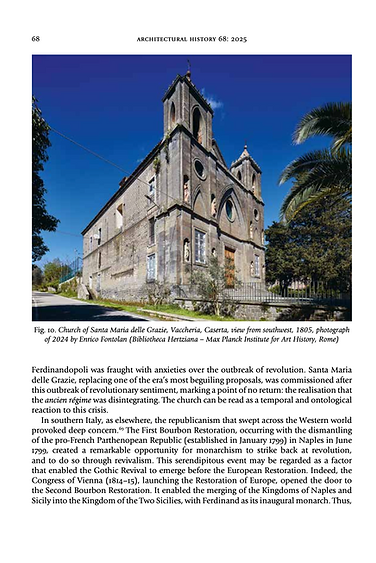
By considering reaction to revolution in Europe during the late eighteenth and early nineteenth centuries in relation to the rise of the Gothic Revival, this article offers a bold assessment of the interplay between responses to the Middle Ages and political culture. It examines the Church of Santa Maria delle Grazie (1801–05) at the Vaccheria of the royal site of San Leucio, Caserta, in southern Italy, with a view to exploring the reciprocity between what can be seen as a neo-Gothic ‘revolution’, wider political and industrial upheaval, and the historic ties between southern Italy and Sicily within the Mezzogiorno. In focusing on this neglected church, which was commissioned by Ferdinand IV of Naples and III of Sicily, the article aims to transcend the tendency in modern scholarship to discount the Gothic Revival in Italy as merely a superficial matter of taste. Recognising revivalism’s political agency, it is argued that Santa Maria delle Grazie bore witness to a profound stylistic crisis as classicism’s absolutist hegemony waned amid the epochal crisis of monarchical absolutism during the period. In tracing architectural and urban experimentation with respect to reactionism, proto-industrialism and medievalism in southern Italy, both before and after late eighteenth-century revolutionary activity, the Gothic Revival is situated within its proper revolutionary context. By extending considerations to Sicily and situating Santa Maria delle Grazie within the Mezzogiorno — through resonances with its medieval histories, including Norman and Swabian rule, and with contemporary ambitions for cohesion between the Kingdoms of Naples and Sicily — the article argues for the reactionary yet transnational visual and political dimensions of neo-medievalism. In so doing, it elucidates a symbiosis between architecture and medievalism as a formidable conduit for expressing and enacting power in the Age of Revolutions.
“Field Notes on The Colonial Middle Ages: Prolegomena to Architecture between Medievalism and Italian Imperialism”
Architectural Histories 13, no. 1 (2025): 1–12
Imperialism matters, particularly in architectural history. But does medievalism also matter in our field? The reverberations of the medieval in post-medieval architecture are often seen as inconveniences or of peripheral interest in evolutionist, if not modernist, versions of architectural history. Yet the Middle Ages traverse non-medieval spatialities and temporalities, contributing to phenomena like colonialism. The essay proposes that imperialism’s exchanges with medievalism can be excavated at the intersection between architecture and the reception, revision, and resurgence of the medieval past — particularly as it unfolded in the construction of the Italian Empire in Africa and the Mediterranean between 1911 and 1936 — and thereby problematise the prevailing associations with modernism. A more balanced view of the ties between the Middle Ages and the post-medieval period highlights the modernity of responses to the past and draws attention to architecture between these responses and imperialism in cases other than the Italian one.

Image courtesy of the author
“A Home in Rome: Villa Mills and the Palatine Hill”
Papers of the British School at Rome (Cambridge University Press) 91 (2023): 185–239

Prior to the acts of demolition pursued in the ventennio to recover and celebrate the heirlooms of antiquity as the simulacra of a fascist restoration of the Roman Empire, a Gothic Revival villa stood atop the Palatine Hill. A transhistorical palimpsest, this edifice incorporated a portion of the imperial palace that was erected for Domitian after his accession to power (AD 81). Through the disclosure of groundbreaking archival documentation, this article reveals that the Gothic Revival mansion, commonly known as‘Villa Mills’, can be renamed ‘Villa Smith’. It was Robert Smith (1787–1873), a lieutenant-colonel of the East India Company, who embarked on the medievalist makeover rather than the previous owner, a fellow Englishman named Charles Andrew Mills (1770–1846). In spite of an exceptional location in the imperial heart of the Eternal City, knowledge of the nineteenth-century history of the site is very limited and tends to be derived from hearsay and hypothesis, rather than primary information. Drawing on broad textual and iconographical sources, this article aims to fill this gap by reflecting closely upon the relationships in pre-unification Rome between architecture and political and cultural intent, between Italy and Britain, and between modernity and antiquity. After a reconstruction of British presence above the Domus Augustana and an investigation of the person behind the neo-Gothic reworking, the study offers a critical reconsideration of Villa Mills and the character of (Charles Andrew) Mills.
Image courtesy of the author
“The Making of Italy (through the Ephemeral): The First Italian Parliament between State Building, ‘Risorgimental Neo-Medievalism,’ and Glorification of the House of Savoy”
Brill’s Companion to Italian Constitutional History: The House of Savoy and the Making of the Nation-State, 1804–1925, ed. Carolina Armenteros and Andrea Ungari (Leiden, Boston: Brill, 2023): 120–152
[Received a commendation for the Hawksmoor Medal from the Society of Architectural Historians of Great Britain]
On 18 February 1861, Victor-Emmanuel II opened the first sitting of the Italian Parliament with a solemn speech. On 17 March, the last King of Piedmont-Sardinia was proclaimed the first King of Italy. These key moments in the construction of the Italian state took place in the chamber that had been built at the rear of Palazzo Carignano to provide the deputies of the Subalpine Parliament (growing in numbers as a result of the annexations of 1860) with interim accommodation. The temporary architecture that hosted the first Italian Parliament in Turin between 1861 and 1865, and that was demolished with the transfer of the capital to Florence, has been afforded very little scholarly attention. Through a focus on this project, the chapter explores the ways in which politics, architecture, and the reworking of the Middle Ages interacted vis-à-vis the Italian unification. It suggests that medievalism and its architectural manifestation played significant roles in entwining national and dynastic narratives and expressing notions of constitutional power alongside the ‘making’ of Italy. The Parliament building emerges as a propagandistic instrument to reach a broad public and a transitional artefact of political culture. A meaningful example of how the medieval past was policitised in the Risorgimento, this edifice materialised the attempt to forge the identity of the nation through medievalist rhetoric. In short, the chapter suggests that the construction in which Italy was ‘made’ also contributed to the ‘making of Italians’.

“‘Neo-Medievalism Studies,’ Italy, and the Four Ghosts: Architectural History and the Study of Medievalism”
Journal of Art Historiography 26 (2022): 1–25
[A previous version received the Barrie Wilson Award from the Edinburgh School of Architecture and Landscape Architecture]

This historiographical piece has two main objectives. On the one hand, it sets out to offer the first sustained discussion of the study of – and the tendency to ignore, underestimate, and criticise – Italian neo-medieval architecture. On the other, by focusing on the Italian case, it reflects on the interplay of architectural history and medievalism studies, making the special claim that, if medievalism and medievalism studies can be defined as the responses to the Middle Ages and the study of those responses, respectively, then ‘neo-medievalism’ and ‘neo-medievalism studies’ shall describe the architectural and artistic manifestations of medievalism and their study. Using the analogy of the ‘Ghost of the Present’, the ‘Ghost of the Future’, and the two ‘Ghosts of the Past’, the article opens by discussing the reasons for the neglect and marginalisation of, and bias towards, Italian neo-medieval architecture. After reconstructing a critical history of the key episodes in scholarship that has touched upon Italian neo-medieval architecture, it proposes an analysis of the notion of – and an apologia for the study of – neo-medievalism beyond the boundaries of space, style, and time.
“‘Immensa, misteriosa, leggera, fantastica, degna del Dio vivente’: Luigi Cibrario e la rinascita risorgimentale dell’architettura medievale”
Studi Piemontesi 50, no. 2 (2021): 523–528
In Dialogo tra un Pedante ed il Medio Evo, the novella in the form of a dialogue published in the Novelle (1836) of Luigi Cibrario (1802-1870), the «Middle Ages» remark to the sceptical «Modern Pedant», their «enemy»: «I do not boast of statues and colosseums but of an architecture that is immense, mysterious, light, terrific, worthy of the living God». 2021 marks the bicentenary of Cibrario’s graduation in literature. A “friend” of Charles Albert, the statesman-historian climbed to the upper levels of Turinese society and was nominated the Secretary of the Deputazione di Storia Patria (1833) and Senator (1848). An expert in economic, Sabaudian, and Medieval histories, he was a better «lord» of the Middle Ages than a «master of the past». His works enable to disentangle a «Sabaudian Medievalism» – of which Cibrario was the «grand puppeteer» – and broader Subalpine and Italian medievalisms, but also to tackle negative readings of pre-union Medieval revivalism as a superficial matter of taste of the Romantic Era (a «foreign [and «accidental»] remnant») and unveil the relationship between the reworking of the Middle Ages, Risorgimento, and rebirth of Medieval architecture. Cibrario was neither an architect nor an architectural historian/theorist. Yet his works – which, among a wide range of interests, embrace architectural history – are an instrument (external to academia and architectural practice) to challenge the historiographical topos according to which the relationship between style and culture was «never sustained» in the pre-union context, and to outline a Risorgimento rebirth of Medieval architecture and explore its popularisation.

“Pelagio Palagi’s Floating Castles: ‘Risorgimental Neo-Medievalism,’ Architectural Ephemera, and Politics at the Court of Savoy”
Architectural Histories 9, no. 1 (2021): 1–17
[Shortlisted for the Alexander Prize from the Royal Historical Society]

In 1842, the court artist Pelagio Palagi (1775–1860) devised four temporary floating castles on the river Po for the remarkable urban celebrations for the nuptials of His Royal Highness Victor Emmanuel of Savoy-Carignan (1820–1878) to Her Imperial and Royal Highness Maria Adelaide of Habsburg (1822–1855) in Turin. The structures formed the central pieces of a broad medievalist programme that, during the reign of Charles Albert of Savoy-Carignan (1831–1849), brought the Middle Ages back to life in the Kingdom of Piedmont-Sardinia. Challenging the classicised image of the Sabaudian monarchy, this article insists that neo-medieval architecture and the architectural style that I call ‘Risorgimental neo-medievalism’ mirrored a calibrated medievalist and royalist strategy against the background of Italy’s ‘resurgence’. Countering recurrent biases that read Italian revivalist architecture as an exercise in taste, it discusses Palagi’s designs as the tools of a political reworking of the Middle Ages, in open dialogue with the disciplines of architectural history and medievalism studies. By reading the urban festivities staged in the capital as a strategically orchestrated political act, this article assesses the medievalist initiatives, culminating in the spectacle on the river Po, as propagandistic vehicles to convey meaning to a vast public, which underscore the role of medievalist rhetoric in challenging the dominant classicist iconography and forging the ‘identity’ of the modern Sabaudian nation.